
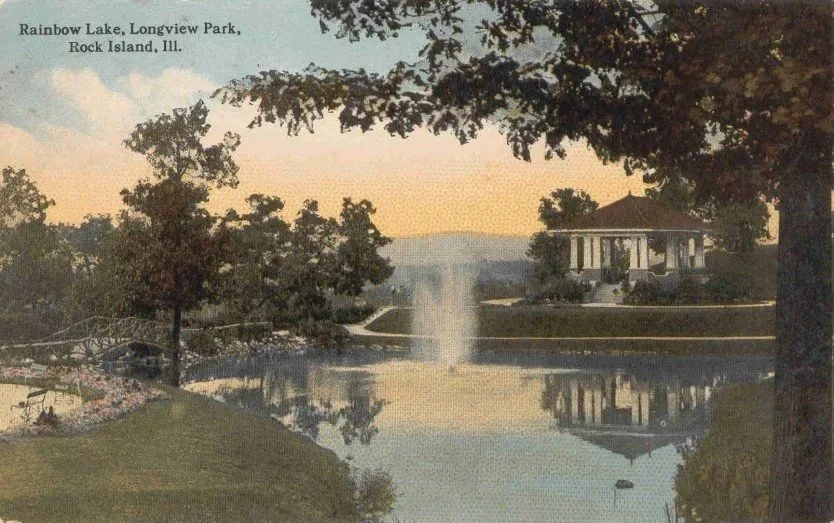
Welcome to Longview Park!
About Us
Friends of Long View Park was formed as a non-profit corporation in 1997 to:
build stronger working partnerships among citizens and neighborhoods of the City of Rock Island and the Rock Island Park Board;
to improve the quality of and pride in Long View Park through education and enhancement activities;
recommend to the Rock island Park Board programs, activities, improvements and strategies for addressing increased usage and
public enjoyment of Long View Park and to improve aesthetic and historic qualities of Longview Park!
Leadership
President: Tom Sparkman
Vice President: Dr. Todd Linscott
Treasurer: Mary Bain
Membership: Paul Fessler
Secretary: Holly Sparkman
History
For half a century, the sloping hills we know today as Long View Park in Rock Island, Illinois, was a part of the Bailey Davenport estate. In 1891, after Bailey’s death, prominent Rock Island and Moline businessmen Frederick Weyerhaeuser, Charles H. Deere, Morris Rosenfield and T.J. Robinson, bought much of the Bailey Davenport land at auction.
In 1897, Rock Island Mayor, Thomas Medill approached the group of owners, asking them to donate Bailey’s pasture to the city. They agreed with the condition that the land be used for a public park. Residents were asked to submit name ideas and from these suggestions the name “Long View” was chosen. After five years of barbed wire surrounding the former pasture, a Long View Improvement Association was formed and quickly moved to retain the services of Chicago landscape designer O. C. Simonds.
Ossian Cole Simonds was one of the earliest American landscape designers to replace formal precision and non-native garden plantings with native species forming natural – appearing spaces. Sometimes called the American Romantic landscape style, its strong Midwestern roots are better reflected in the term “Prairie style landscape.”
O.C. Simonds was born near Grand Rapids, Michigan. He grew up on his family’s farm and attended the University of Michigan where he studied civil engineering and architecture. Following graduation,
Simonds went to work for the noted Chicago architect and planner, William LeBaron Jenney where his early task was surveying the even-then-famous Graceland Cemetery. In 1881, after Graceland expanded, Simonds was hired as its supervisor. With a goal of creating the ultimate restful landscape, he moved tons of earth and built a rolling topography, complete with several small lakes. Then he planted native shrubbery and trees for a final result appearing more like a park than a cemetery.
Contact Us
Interested in working together? Fill out some info and we will be in touch shortly. We can’t wait to hear from you!